111
111 2
2 3
3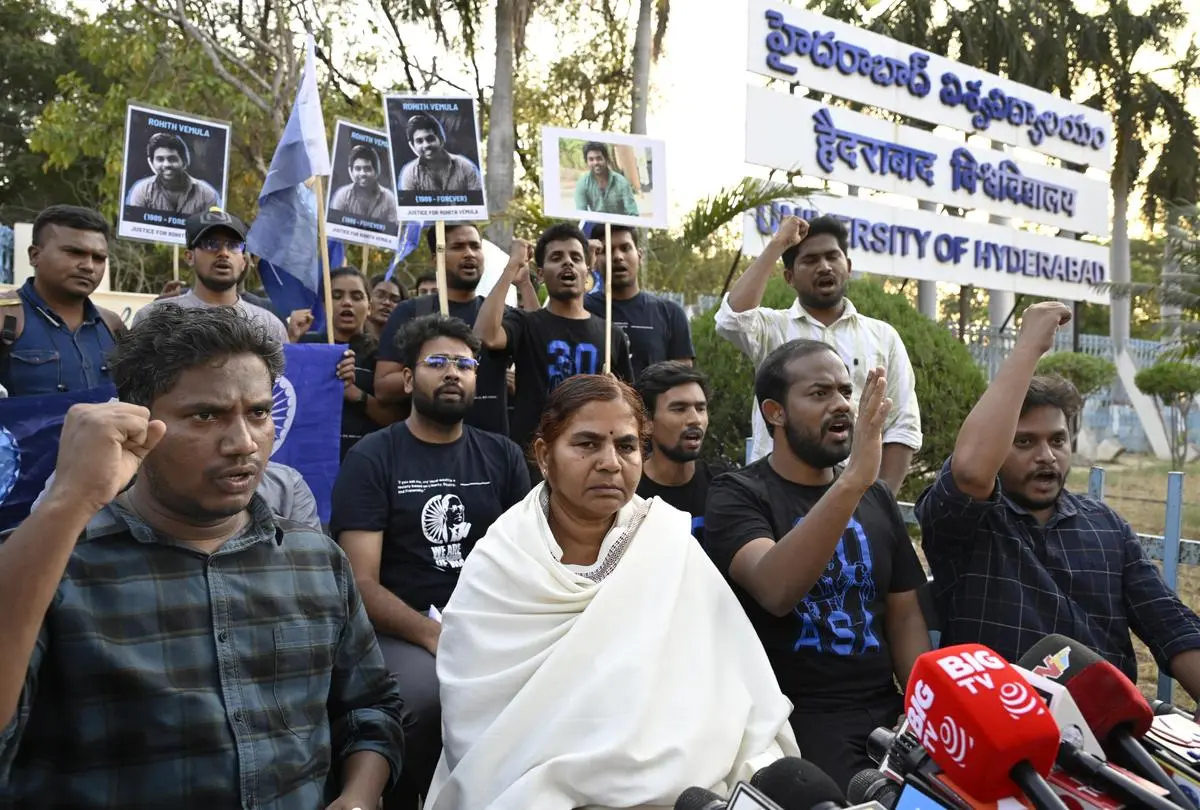
“All my adult life, I’ve been trying to bring my people into a system that proclaims every day that this is not our place,” said Professor (Dr) Sonajharia Minz, one of India’s first tribal Vice Chancellors. Minz is a professor at the School of Computer and Systems Sciences, JNU, New Delhi. She has been teaching since 1990 and has chaired various committees that focus on redress mechanisms. From caste-based discrimination to reserved seats lying vacant for years to promotions denied because of caste, she has seen and tried to repair much. “But I often ask myself, when a nation is being built, whose responsibility is it to ensure that every institution is equitable for everyone?”
Minz’s question is the bedrock of any conversation on constitutional entitlements in educational institutions, their implementation, and the necessary safeguards. But the last-mile delivery of the foundational principle of the Constitution—the right to equality—has somehow been evaded since Independence. More so in educational institutions, where no authority is willing to accept the accountability of making institutions comply with the principles of equality. On paper, they seem designed for inclusion, but in practice, there is stark exclusion in every sphere.
The widespread protests across north India led by dominant castes following the announcement of the University Grants Commission (Promotion of Equity in Higher Education Institutions) Regulations, 2026, are the most recent example of the persistent inequality. The protests culminated with the Supreme Court swiftly staying the regulations. At the centre of the protests were claims that the guidelines would protect oppressed-caste students and discriminate against oppressor-castes such as Brahmins and other savarnas.
Matharasu’s daughter is a first-generation college student. Being from the Puthirai Vannar community, the fear that her daughter will face discrimination haunts Matharasu all the time. While most Scheduled Caste communities are labelled “polluting” by touch, the Puthirai Vannars, often called Dalits within Dalits, face a deeper stigma: they are considered polluting merely by sight. It is only after nearly two decades of mobilising that the Tamil Nadu government finally carried out a census of this community in 2025. Matharasu, an activist, has been at the forefront of the struggle for a decade, travelling from village to village, questioning the atrocities her people face and fighting to bring them closer to their constitutional entitlements.
Matharasu first spoke to her daughter about caste when her teacher enquired about it to apply for a State scholarship on her behalf. When the child returned home from school, Matharasu told her about all the realities of belonging to the Puthirai Vannar community. As her daughter prepared for college, Matharasu extracted a promise: that she would confide in her in case of any untoward incident.
The new University Grants Commission (UGC) guidelines, too, were drafted because of an appeal made by two mothers whose children died on campus after facing caste-based discrimination. Radhika Vemula and Abeda Salim Tadvi, mothers of Rohith Vemula (PhD scholar) and Payal Tadvi (PG medical student), filed a PIL petition in 2019, which languished in court for six years. In 2025, the Supreme Court finally directed the UGC to draft fresh guidelines to prevent and penalise caste-based discrimination and oppression.
Also Read | UGC equity rules are a carefully curated political gesture: Anand Teltumbde
The nationwide protests that followed the death of Rohith Vemula forced even the BJP, whose ideology is founded on preserving caste structures, to reluctantly issue the Supreme Court-mandated UGC regulations on January 13, 2026. Spokespersons of the BJP’s student wing, the Akhil Bharti Vidyarthi Parishad, whose leaders were at the forefront of mobilising powerful BJP leaders against Rohith Vemula, told Frontline that they accepted that there was caste discrimination on campus and that they supported the new guidelines. Although this seems to be the official stand, many leaders of the BJP have openly opposed or even resigned in protest against the guidelines.
More than a decade ago, in 2012, close on the heels of the Sukhadeo Thorat Committee Report that looked into the allegations of “differential treatment of SC/ST students” at the All India Institute of Medical Sciences, New Delhi, the UGC released a set of regulations to prohibit discrimination based on caste, religion, gender, language, or disability. It was the failure of the 2012 regulations that was highlighted by the two mothers, who specifically pleaded for a mechanism that was not just advisory but oriented to fix disparity and penalise institutions that failed to do so.
In fact, the latest regulations were criticised when the draft was released in 2025 for diluting even the existing 2012 regulations. Indira Jaising and Disha Wadekar, lawyers for the petitioners, and activists proposed amendments, some of which were carried out. Even so, the 2026 regulations are not perfect.
“The functionality of such regulations depends on what you are proposing conceptually, but that is not clear here. One can’t tell how these regulations will be implemented; it reads like an experiment,” Minz said. The most glaring loophole is that they expect oppressed-caste students to rely on a system that is exclusionary by design.
When higher education institutes are clearly seen as centres of exclusion, for the institution and an Equal Opportunity Centre set inside it to be vested with the power to define discrimination—which is what the 2026 regulations do—is disingenuous, said Professor Minz.
The 2012 regulations, on the other hand, defined 28 forms of discrimination faced by SC/ST students on the basis of a thorough study carried out by the Sukhadeo Thorat Committee. “Discrimination has to be defined equally clearly in the 2026 regulations as well, according to the category, by similar committees,” Minz said, explaining that discrimination faced by every social category falls under different ambits, and there is a need to identify them separately.
The University of Hyderabad (formerly known as Hyderabad Central University, or HCU), where Rohith Vemula studied, is often referred to as a caste-ridden campus. On the first anniversary of Vemula’s death, his mother, Radhika Vemula, fought through police barricades to reach the stage. Amidst the demands to seek action against those responsible for his death, including the Vice Chancellor at the time, Appa Rao Podile, she made her first speech since her son’s death, in which she highlighted everything that was wrong with the system, including how it protected people like Appa Rao, who had a history of making casteist statements.
This is vividly described by the senior journalist Praveen Donthi in “From Shadows to the Stars: The defiant politics of Rohit Vemula and the Ambedkar Students Association”, a 2016 report published in The Caravan on the history of Ambedkarite assertion in HCU. Radhika Vemula vowed to do everything she could “to stop more Appa Raos from preying on Dalit students”.
Radhika Vemula sits in protest, demanding justice for her son, Rohith Vemula, outside the University of Hyderabad on May 4, 2024, after the Telangana Police filed a 60-page closure report in his suicide case.
| Photo Credit:
NAGARA GOPAL
Before this, the UGC’s obvious lack of will to implement the 2012 regulations hardly ever came under scrutiny even though the UGC itself owned up to a spike in complaints of casteism, submitting data to the Supreme Court that showed a spike of 118.4 per cent in the number of complaints of caste-based discrimination over five years, from 173 in 2019–20 to 378 in 2023–24.
The 2026 regulations, thus, become even more important, despite the various other deficiencies that Minz mentions. Perhaps the most glaring lacuna is the fact that higher educational institutions such as the IITs, IIMs, National Law Schools, and other independent institutions are not included at all.
These problems are now moot, with the Supreme Court staying the regulations until further scrutiny. The intensity of the protests, however, forces a closer look at the design of caste that refuses to break a pattern whereby the anxieties of the dominant castes receive paramount focus.
The intolerance against any measures seeking to enforce equality in educational institutions goes back to the early years after Independence. In 1951, Champakam Dorairajan, a Brahmin woman from Tamil Nadu, approached the Madras High Court claiming that a government order that sought to allots seats in educational institutions proportionate to the State’s population— thereby facilitating entry for oppressed castes, tribes, and minorities—discriminated against her. The High Court, and subsequently, a five-judge bench of the Supreme Court, struck down the order, endorsing Dorairajan’s argument that affirmative action was discriminatory. Almost everyone, from lawyers to judges in both courts, were Brahmins.
It took a constitutional amendment to eventually pave the way for reservation in India. India’s tryst with equality is, unfortunately, tainted at the very constitutional court that exists to safeguard the right to equality.
The journey of the Supreme Court, from this 1951 judgment to its observations in 2026 on the UGC regulations that came close to denying the reality of caste, only proves the point that many people have repeatedly made: India’s institutions have not evolved in tandem with social progress. If anything, they have only become more regressive. Rather than find ways to strengthen the new regulations, the Supreme Court made observations that were identical to what was being said on prime-time television and on the streets by dominant-caste protesters. Social morality took precedence over constitutional morality in the court.
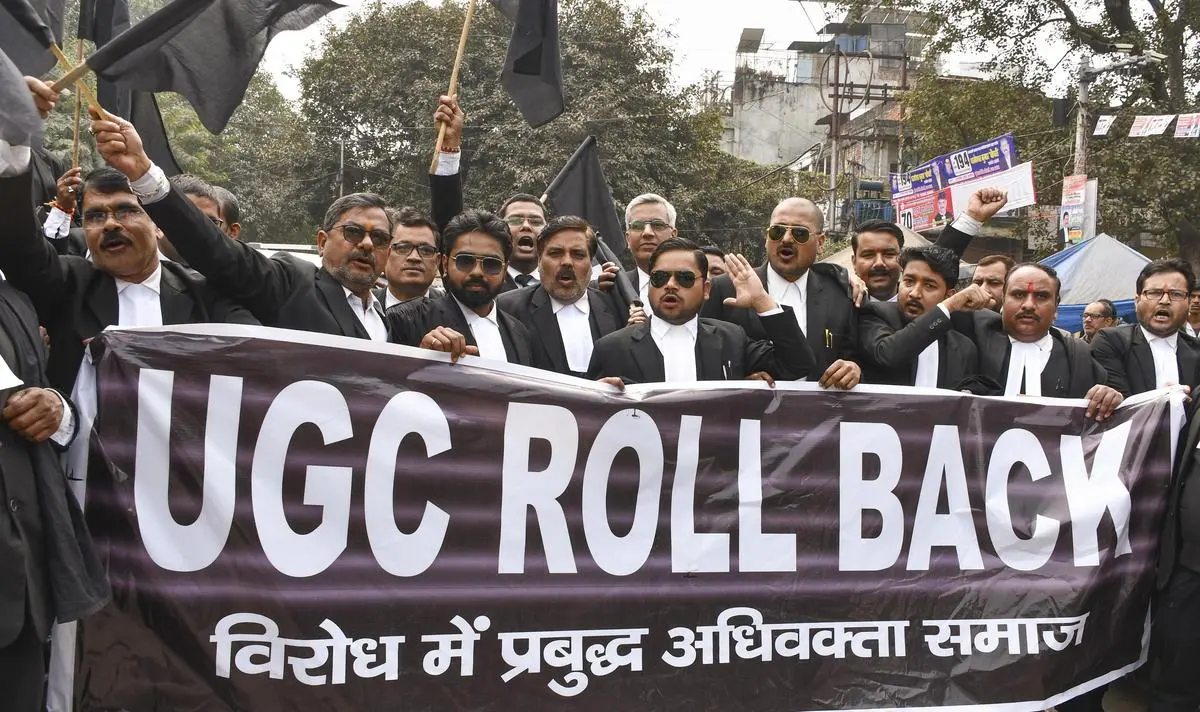
Advocates of the Allahabad High Court protest against the new UGC regulations, in Prayagraj on January 29.
| Photo Credit:
PTI
The PIL petition, filed by Mritunjay Tiwari, a Brahmin PhD scholar studying at Benaras Hindu University, alleging violation of the right to equality, was clubbed with two related petitions, and the Supreme Court posed four questions of law to the UGC. First, it asked if there was a need for the UGC to define “caste-based discrimination” exclusively as opposed to just “discrimination”, which the court said was more “exhaustive and inclusive”. Second, it asked if these regulations had safeguards to protect sub-castes. Third, it asked for clarification on why the word “segregation” was used in the guidelines in the context of hostels, classrooms, and mentorship groups. The final question pointed to the absence of the word “ragging” in the context of discrimination and asked if this omission led to “unequal treatment of victims of discrimination by creating an asymmetry in access to justice”. It went on to declare that this “asymmetry” was violative of the right to equality and life.
If one looks at these questions closely, it appears that the historic anxieties of the dominant castes and those of the Supreme Court have almost merged into one.
Regardless of the fact that there are laws in place against ragging—including the UGC Regulations on Curbing the Menace of Ragging (2009), two Supreme Court directives (2001 and 2009) banning ragging, anti-ragging laws enacted by individual State governments, and sections in the Bharatiya Nyaya Sanhita—the specificity of the term “caste-based discrimination” as “discrimination only on the basis of caste or tribe against the members of Scheduled Castes, Scheduled Tribes, and Other Backward Classes” seems to have unsettled the apex court.
Rather than refer to existing anti-ragging regulations, the Supreme Court posed a hypothetical situation: “If a general category fresher resists ragging by a SC senior, there is a chance that the latter could file a complaint under the 2026 Regulations while the former has no remedy. The fresher could be charged, put behind bars, and his future would come to an end possibly on the very first day of college.”
The petitioners also claimed that empowering only SC, ST, and OBC students to report “caste-based discrimination” would result in general category students being deprived of the same protections. Rather than question the veracity, frequency, and intensity of such a claim of reverse discrimination, the Supreme Court said such a clause would indeed “have sweeping consequences which will divide the society”.
Further, the Chief Justice asked rhetorically whether the 2026 UGC regulations were not regressive in themselves. Especially, he said, since India has made substantive gains in the past 75 years “towards forging a casteless society”.
Two major themes arise from the Supreme Court’s observations: first, caste does not appear to the court to be as big a problem as the students claim. Both judges asked the UGC why it was “exclusively focussing on caste”, almost forgetting that the UGC’s new regulations originated from a Supreme Court mandate.
The second theme that emerged from the ruling was the repeated insistence on the misuse of the regulations and false complaints. The Supreme Court’s observations were discretionary but making them in public is to set a narrative in stone without concrete data.
The “Report on Judicial Conceptions of Caste”, released by the Supreme Court’s Centre for Research and Planning, examines how the apex court has dealt with caste over the decades. One of its findings is that the court has over the years made statements based on stereotypes rather than evidence. For instance, this observation in State of Kerala v. N.M. Thomas (1976): “[I]t would be unwise and impermissible to make any reservation at the cost of efficiency of administration.” Or Justice V.R. Krishna Iyer’s observations in the same case: “[Y]ou cannot grind the wheels of Government to a halt in the name of ‘harijan welfare’.” Such comments feed from popular tropes rather than evidence to reinforce the idea that the concerns of the oppressor castes are meritorious and others are not.
In many such instances, the Supreme Court seemed to reproduce the formulations of the petitioners. Nobody presented concrete data or empirical evidence on what constitutes caste-based discrimination against dominant castes and who discriminates against them, but the court stated it as a fact.
The data that do exist are troubling, but rarely spoken about. The 1965 Committee on Untouchability, Economic and Educational Development of the Scheduled Castes, headed by the three-time MP and social reformer L. Elayaperumal, was the first national committee established by the Department of Social Welfare to examine how untouchability practices persist, to understand if laws are being used to combat untouchability, and to learn what the gaps in enforcement are. In its findings submitted in 1969, the committee documented widespread caste discrimination and untouchability in educational institutions, from elementary schools to higher educational institutions. It reiterated that untouchability continued as a social reality despite constitutional guarantees primarily because the government was not doing anything to actively discourage the practice.
Another finding was that dominant castes were accessing reservation by having their children “adopted” by SC parents and using the adoption certificate to enter the reserved category. In some institutions the committee visited, the majority of reserved seats were filled in this way. Reservation has for years been encroached upon, but such instances are seldom reported. In fact, caste on campuses began to be reported only after the Mandal Commission protests of 1990 that were backed by the might of the media, itself dominated by Brahmin-Savarnas.
All the recommendations of the Elayaperumal Committee to address untouchability were ignored. It was only after two decades and severe pressure from Dalit organisations that the Scheduled Caste and the Scheduled Tribes (Prevention of Atrocities) Act, 1989, was finally brought in. Another recommendation was to appoint Liaison Officers in every State to address caste discrimination in educational institutions. It was not until 2012 that safeguards came into place, after multiple suicides and social mobilising. Students who had faced systemic caste-based discrimination as documented up until then had no other option but to suffer in silence.
Today, the situation continues, even in schools. In September 2024, in Karnataka’s Yadgir district, the helper-cook in a midday meal programme refused to wash plates used by Dalit children. In November 2025, an anganwadi in Odisha’s Kendrapara district was boycotted when a Dalit woman was appointed as helper-cook. In July 2022, 9-year-old Indra Meghwal was brutally beaten up by his teacher for drinking water that was meant for savarnas at his school in Rajasthan’s Jalore district. The student succumbed to his injuries. In December 2025, an inquiry was launched when a government school in Bihar’s Alawalpur village was reported as segregating students on the basis of caste. Multiple reports of caste violence in schools in Tamil Nadu resulted in the government appointing the Justice Chandru Committee in 2024 to document and suggest remedies.
Thus, the Supreme Court’s assertion that “caste cannot be the only way to look at discrimination on campuses” denies the lived realities of the many hundreds of students who face discrimination today and those who faced it in the past. A superficial judicial interpretation should not obscure the real and lived historical, social, and economic disadvantages that people face.
There is a pattern in how the experience of caste-discrimination in higher education institutions has been kept under wraps. “I don’t remember conversations around caste in the media when I was growing up. Nor did the government actively speak about caste as graded inequality, at the root of which was dehumanisation,” said Minz.
Dr Ravichandran is a first-generation MBBS student from Tamil Nadu, from a village where untouchability is still practised. Dr Ravichandran studied hard to escape caste, getting the highest scores in his village school, then making his way to medical college. In the 1980s, he said, segregation was open, despite anti-caste movements and the presence of Tamil leaders such as Iyothee Thass Pandithar and Periyar. Caste followed Ravichandran to college. Students from the reserved category, said Ravichandran, carried the permanent stamp of their SC status like an insult. This was besides segregation in the mess, differential treatment from professors, and lowered grades to prevent access to postgraduate education.
Dr Suresh pursued his medical education in the 1980s in Uttar Pradesh, where caste-based violence was even more rampant. “Around this time, we started speaking up about differential treatment and how we were being kept away from progress by caste lobbies,” he said.
Today, although Dr Suresh is the head of a department at a State university and Dr Ravichandran runs a successful private practice, the barriers persist. “Most private hospitals and colleges are owned by dominant-caste people, and you will notice that Dalits don’t make it past a certain level,” said Dr Ravichandran. “Caste follows you through life. The notion that discrimination ends once you enter university is wrong.”
Also Read | When justice is branded as ‘divisive’
There are hundreds of such instances of caste discrimination that do not feature in mainstream reportage. The persistence of caste-based discrimination and its misrepresentation are closely tied to how we speak about caste. And how we do not speak about caste. This lack of scrutiny was underscored by the government’s recent refusal to disclose data on the caste-wise and category-wise (SC, ST, and OBC) representation of officers in the All India Services. An RTI-based report by The Indian Express reveals that SCs, STs, and OBCs are significantly under-represented in senior government and academic positions. Of the 40 Central universities, where OBC reservations apply up to the level of assistant professor, OBCs hold just 14.38 per cent of the positions. There are no OBC professors or associate professors, despite 27 per cent reservation.
Representation among SC s and STs at Central universities is similarly low; only 3.47 per cent of professors are SC and 0.7 per cent are ST. At the level of associate professor, 4.96 per cent are SC and 1.3 per cent are ST; for assistant professors, the numbers are 12.02 per cent for SC and 5.46 per cent for ST. The numbers for non-teaching university staff, too, reflect this disparity, with 8.96 per cent for SC, 4.25 per cent for ST, and 10.17 per cent for OBC, compared with 76.14 per cent in the general category.
In the Ministry of Human Resource Development, out of 665 Group A and B officers, 66.17 per cent belong to the general category, while SCs account for 18.94 per cent, STs 6.47 per cent, and OBCs only 8.42 per cent. In the Railways, among 16,381 Group A and B officers, just 8.05 per cent are OBC.
These figures point to a substantial gap between reservation entitlements and actual representation. Historically the standard response to such unfilled vacancies has been indifference or silence. Despite the continuing disparity, the spending on SC, ST, OBC and minority students has reduced considerably over the past decade, as the Congress president Mallikarjun Kharge pointed out in the Rajya Sabha on February 4. This is despite funds being allocated for the purpose under various schemes, he said, questioning the fund underutilisation. His remarks were expunged.
The protests against the UGC regulations this year played out in the same way as in the 1990s, but with one addition: social media. Under the #UGCRollBack hashtag, social media floated a wave of caste anxiety, with short videos that projected the victimhood of dominant-caste members and individual stories of suffering.
Such a display is not surprising since the country is seeing a resurgence of caste pride. Almost every caste crime these days is invariably followed by a display of caste identity and impunity by the perpetrator. It would be right then to say that the opposition is not owing to any misunderstanding of the UGC regulations but rooted in fears of the disruption of the established social order and hierarchy that such regulations might bring; the anxiety that they might give social groups a mechanism to point to wrongdoing, demand redress, and claim their constitutional right to equality in higher educational institutions.
The legal foundation of the UGC guidelines is located in the constitutional assertion that higher educational spaces must be equally accessible to all. This assertion was made in the Constitution in the face of historical social hegemonies being replicated in educational spaces as well. However, the physical entry of the oppressed castes into such spaces has been followed not by acceptance but by resentment, leading to their humiliation, degradation, and persecution by dominant-caste students and faculty. The proposed UGC regulations came about because of long-fought battles based on lived experiences. By stalling them, what has been stalled is the last-mile delivery of Article 14.
Suguna is from the Irula community, classified as a Particularly Vulnerable Tribal Group. The first Irula in her region to finish school, she was spotted by some activists who facilitated her admission into an aided private college. It was here that she learnt she was eligible for a tribal scholarship. “I did not know until college that I was entitled to reservation,” said Suguna. But she struggled to get an ST certificate: officials denied she was Irula on the basis of statements made by dominant-caste panchayat officials in her village. Suguna, whose parents work in brick kilns, was asked if she was familiar with practices associated with the Irula such as catching rats or taming snakes to establish her identity. “I did feel vulnerable when I started college; I felt I didn’t belong, but I focussed on pulling myself out of the shackles of my identity. I knew only education could do that.”
For education to pull people out of caste, effective regulations are needed to ensure that all students access the same education with the same ease and rights. As Matharasu said: “If the intent is to ensure our children don’t face historical prejudice and are treated as equals in educational institutions, then the government and the UGC have a legal responsibility to do better.”
Greeshma Kuthar is an independent journalist and lawyer from Tamil Nadu.