 111
111 23
23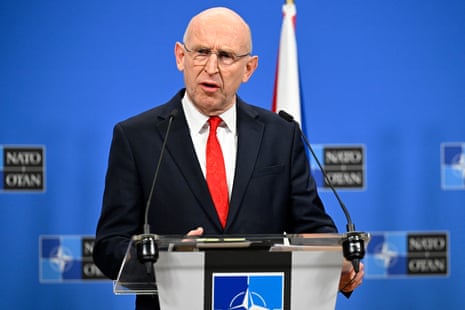
The UK’s defence secretary, John Healey, has written in the Sunday Telegraph saying he wants to deploy British troops to Ukraine as it would signal an end to Russia’s war, days before the fourth anniversary of the full-scale invasion. Here is an extract from what he wrote:
There is no heavier burden on any defence secretary or any government than committing our armed forces on operations.
I want to be the defence secretary who deploys British troops to Ukraine – because this will mean that this war is finally over.
It will mean we have negotiated peace in Ukraine. And a secure Europe needs a strong, sovereign Ukraine.

European leaders said in December that Europe was ready to lead a “multinational force” in Ukraine as part of a US proposal for a peace agreement, which has so far appeared elusive due to Moscow sticking to its maximalist demands.
The leaders of the UK, France, Germany and eight other European countries said troops from a “coalition of the willing” with US support could “assist in the regeneration of Ukraine’s forces, in securing Ukraine’s skies, and in supporting safer seas, including through operating inside Ukraine”.
The UK government is currently working alongside allies to establish the so-called “coalition of the willing” which is hoped to deter future Russian aggression once a deal has been agreed to between Moscow and Kyiv.
Key events
The UK’s defence secretary, John Healey, said he wants to deploy British troops to Ukraine as it would signal an end to Russia’s war.
Shadow education secretary Laura Trott said the Conservatives wanted funding to be scrapped for “dead-end university courses”, such as creative art courses, which she said were leaving graduates with weaker job prospects.
Trott also said the Tories would oppose any special educational needs and disabilities (Send) support being withdrawn amid reports that under school reforms for England children with education, health and care plans (EHCPs) will be reassessed after primary school from 2029.
The education secretary, Bridget Phillipson, vowed that Send reforms will “transform support for children and families” and said the government would not be withdrawing “effective support” from children with special educational needs and disabilities under its proposals, which will be unveiled in full tomorrow in the schools white paper.
Phillipson pledged that under the government’s overhaul of the Send system it will take weeks for children to get access to support, not months or years.
The schools white paper, which could face major opposition from Labour MPs, is also expected to set a target to halve the disadvantage gap by the time children born in this parliament finish secondary school.
The government is under growing pressure to alter what is widely seen as unfair system regarding “plan 2 loans” affecting millions of people who took out the loans between 2012 and 2023 and are now saddled with huge interest-laden debts. Bridget Phillipson insisted she wanted “fairer” arrangements for graduates but warned the government was dealing with “a question of priorities” when asked whether the burden would be eased.
Searches are continuing at Andrew Mountbatten-Windsor’s previous home as the government did not rule out a judge-led inquiry into the former prince’s links with Jeffrey Epstein following police investigations.
Thanks for joining us. We are closing this blog now. You can find all our latest coverage of UK politics here.

Lisa O’Carroll
High-level talks with the US administration over the threat of increased tariffs are under way as the UK government says it wants “the best possible deal” for UK companies.
Business leaders said they expected the UK to “double down” on the existing Economic Prosperity Deal (EPD) – announced by Donald Trump and Keir Starmer in May last year – rather than walk away.
Trump’s deals with about 20 countries, including the UK, the EU, Switzerland, Japan, Lesotho and others, were put in doubt on Friday after the US supreme court ruled that the president’s existing “reciprocal” tariffs were illegal.
The ruling infuriated Trump, who on Saturday announced a 15% global tariff on all foreign imports, under the 1974 Trade Act, a different legal framework to the one investigated by the US supreme court.
It would potentially mean a 5% increase in the existing 10% tariff for UK exporters and a possible rise for EU exporters, too, as the 15% deal it secured was “inclusive” of previous tariffs and the new tariff is not.
The UK education secretary, Bridget Phillipson, admitted on Sunday that UK businesses faced “uncertainty” after the latest developments but insisted in an interview on Sky News that the UK expected its “preferential” trade arrangements with the US to continue. You can read the full story here:
In an interview with the Russian state news agency Tass, Russia’s foreign minister, Sergei Lavrov, previously said any European troop contingents sent to Ukraine would be considered by Russian forces as legitimate military targets.
Lavrov said:
These ambitions (of European officials) have literally blinded them. Not only do they not care about the Ukrainians but they do not care about their people either.
This is the only way to explain the fact that there is still talk in Europe about sending military forces to Ukraine as part of the so-called coalition of the willing. We have said many times that in this case our armed forces would view them as a legitimate target.
The UK’s defence secretary, John Healey, has written in the Sunday Telegraph saying he wants to deploy British troops to Ukraine as it would signal an end to Russia’s war, days before the fourth anniversary of the full-scale invasion. Here is an extract from what he wrote:
There is no heavier burden on any defence secretary or any government than committing our armed forces on operations.
I want to be the defence secretary who deploys British troops to Ukraine – because this will mean that this war is finally over.
It will mean we have negotiated peace in Ukraine. And a secure Europe needs a strong, sovereign Ukraine.
European leaders said in December that Europe was ready to lead a “multinational force” in Ukraine as part of a US proposal for a peace agreement, which has so far appeared elusive due to Moscow sticking to its maximalist demands.
The leaders of the UK, France, Germany and eight other European countries said troops from a “coalition of the willing” with US support could “assist in the regeneration of Ukraine’s forces, in securing Ukraine’s skies, and in supporting safer seas, including through operating inside Ukraine”.
The UK government is currently working alongside allies to establish the so-called “coalition of the willing” which is hoped to deter future Russian aggression once a deal has been agreed to between Moscow and Kyiv.

Jessica Elgot
Jessica Elgot is the Guardian’s deputy political editor
Kemi Badenoch has said the Conservatives would scrap the “unfair debt trap” of high interest rates on student loans, piling pressure on Labour ministers to tackle the growing outrage over the high costs.
The education secretary, Bridget Phillipson, admitted the system of plan 2 loans had “problems” but suggested the government’s priority would be maintenance grants for poorer students, rather than tackling the high interest rates …
“Britain’s young people are facing a worse deal under Labour,” Badenoch said. “Youth unemployment is at its highest level in a decade, graduate recruitment is at the lowest level on record, and too many are going straight from education to welfare. Leaving university has become a moment of despair. Not just for young people but their parents too.
“In particular, the plan 2 student loans are an unfair debt trap: millions of graduates are doing the right thing, paying every month, yet watching the balance they owe growing bigger because interest piles on faster than repayments. If Labour had any sense, Rachel Reeves would act now and use her spring statement to adopt this plan.”
You can read the full story here:
We can bring you some more comments from the BBC interview with shadow education secretary, Laura Trott, this morning.
Trott said the Conservatives wanted funding to be scrapped for “dead-end university courses”, which she said were leaving graduates with weaker job prospects amid high youth unemployment and a university funding crisis.
Drawing on evidence from a 2020 report from the Institute for Fiscal Studies, which found up to 30% of young people going to university have “negative returns”, Trott said she would like to close 100,000 university places to “alleviate the debt issue” and in order to “increase apprenticeships”.
Trott refused, however, to list examples of the “dead-end” courses when pressed, only pointing to “creative arts courses”. “75% of the loans that are given out on those are not paid back,” Trott said.
Many degrees that are derided as low-value or soft often are meaningful for the students who study them and have valuable economic and cultural impacts that are not always easily quantifiable.
Under Conservative plans, young people starting their first full-time job would also see the first £5,000 of national insurance they pay put into a personal savings account, which could be used to buy a home, the party says.
In other news, former Conservative prime minister Boris Johnson was interviewed by the BBC’s Laura Kuenssberg on Friday, alongside former head of the armed forces Adm Sir Tony Radakin. Both were in their posts when Russia launched its full-scale invasion of Ukraine in February 2022. Here are some of the key lines from the interview, which was broadcast in full this morning:
Radakin said getting the early-morning call on 24 February 2022 was “almost like a relief” because it had been “really clear” Moscow was going to invade and confirmation meant the UK could get on with the task of responding.
Johnson said there was a “weird sense” among some countries at the Munich Security Conference (Feb 18-20 2022) that it may be better – from a “humanitarian perspective” – that Ukraine “folded” so that the war ended “rapidly” – a position he describes as “completely alien” to his way of thinking.
Johnson said his first call was to Ukrainian president Volodymyr Zelenksyy. “I said to him look the key thing is that you protect yourself. And you are the focus of resistance. If you go then it will be a disaster for Ukraine.”
Radakin said it was always “up for debate” whether “Kyiv would fall within days”.
Johnson agreed the UK and its western allies were naive/enabled the full-scale invasion by allowing Russia to annex the strategic Crimean peninsula from Ukraine in 2014, a move seen by many countries as illegal. He said the west’s failure to properly respond “was tragic” and emboldened Russian President Vladimir Putin.
“We could have solved this problem if we had been clear about what Ukraine was. We continually said to them you can join Nato and you are on the path to the west. But we never made good that promise. I think if we had clarity and simplicity about Ukraine, rather than endless fudge and obscurity, we could have prevented that invasion,” Johnson said.
Radakin said that from the Ukrainian perspective the west’s (military/financial) response to the war – which has often been sluggish – feels like “incrementalism” and is “deeply frustrating”.
Johnson said the UK and its allies should deploy non-combat troops to Ukraine right now (in non-fighting roles) to “flip a switch” in Putin’s head.
“There is no logical reason that I could see why we shouldn’t send some peaceful ground forces there to show our constitutional support for a free, independent Ukraine,” the former prime minister said. For context: Britain and France declared last month they were ready to deploy troops to Ukraine in the aftermath of a peace deal.
Former prime minister Gordon Brown has written to six police forces calling for investigations into whether Andrew Mountbatten-Windsor used jets, funded by the taxpayer, and RAF bases during his time as trade envoy to meet up with Jeffrey Epstein, the Sunday Telegraph reported.
Brown’s letters were sent to police in London, Surrey, Sussex, Thames Valley, Norfolk and Bedfordshire this week. Brown – who was Labour prime minister between 2007 and 2010 – reportedly suggested that civil servants be questioned about Andrew’s time as a trade envoy between 2001 and 2011, during which time the former prince had privileged access to government and business contacts.
According to the Sunday Telegraph, the letters sent to the police reflect Brown’s concern that Andrew may have used chartered RAF flights to transport him to personal engagements that could have involved Epstein, and that the former prince may have also leaked confidential information from trips.
Brown wants police to interview officials at the Ministry of Defence, the Department for Transport, the Foreign Office and the Treasury over Andrew’s trade envoy role, according to the report, the contents of which we have not been able to independently verify. Andrew has denied any wrongdoing.
Searches are expected to continue today at Andrew Mountbatten-Windsor’s previous home – Royal Lodge, in Windsor – as calls grow for a probe into the former prince’s links with Jeffrey Epstein.
Lucy Hough speaks to the Guardian’s police and crime correspondent, Vikram Dodd, about what could be next for Andrew here:
Reform UK’s new economy spokesperson, Robert Jenrick, said his party would support legislation to remove Andrew Mountbatten-Windsor from the line of succession.
Speaking to Sky News, Jenrick, who left the Conservative frontbench last month, said:
If the government bring forward this bill with the support of the King then we will back it. We have to be realistic. Andrew is the eighth in line to the throne, so there’s no chance of him becoming our monarch.
And so parliament really should be focused on things that are of more importance to the public, whether that’s the economy, crime, the health service, immigration. But if the bill does come before parliament, then we’ll support it.
My main feeling today… emotion is sadness, really for the King and the royal family because they’ve been let down so badly as, of course, have the victims of Jeffrey Epstein.
The King serves this country extremely well and Andrew has disgraced the royal family, and he’s disgraced our country in the process. And whatever happens, whether he’s ultimately prosecuted or not, he should now just go off, lead a private life and allow the King and the rest of the royal family to continue doing the good job that they do do for us.
Trevor Phillips then asks Bridget Phillipson if the government would be open to an “independent, judge-led inquiry”.
The education secretary said:
We’ll look at any sensible proposals that do come forward. But it’s premature at the moment because we do have the police doing their work.
They need to have the time and space to do so. As the king set out, no one is above the law, and it’s right that the police go wherever the evidence takes them. So that has to be the focus at the moment.
King Charles said on Thursday that “the law must take its course” after detectives took the unprecedented step of arresting his brother Andrew Mountbatten-Windsor on suspicion of misconduct in public office.
“What now follows is the full, fair and proper process by which this issue is investigated in the appropriate manner and by the appropriate authorities,” Charles said in a statement. “In this, as I have said before, they have our full and wholehearted support and cooperation.” Andrew has denied any wrongdoing.
The government is considering introducing legislation to remove Andrew Mountbatten-Windsor, King Charles’s brother, from the line of royal succession.
Andrew was arrested on Thursday on suspicion of misconduct in public office. Police took him to Aylsham police station in Norfolk for questioning about allegations he shared confidential material with the convicted child sex offender Jeffrey Epstein.
Despite being stripped of his title last year, Andrew is still eighth in line to the throne and an act of parliament would be required to remove him and prevent him from ever becoming king.
Asked by Sky News’ Trevor Phillips when the public can expect to see draft legislation excluding Andrew from the line of succession, the education secretary, Bridget Phillipson, said:
So we’re not ruling anything out around this. But we have obviously got a live police investigation under way, so we’ll not be setting out further steps until the police have been able to do their work. And wherever that investigation, wherever the evidence takes them.
Asked if the government is advising King Charles to remove Andrew from the privy council, she said:
So we’ve said that we have to keep all of these options available to us, but you’ll appreciate that because we have a live police investigation under way it’s right that the police are allowed to do their job. Once that is concluded, then of course we’ll consider in discussion with the royal family, with the King what further action is needed.
But I do just think as well, in all of this, we really shouldn’t lose sight of where this began. And where this began was with young women and girls being exploited over an extended period of time by a network of very powerful men. And we can’t ever forget that.
The shadow education secretary, Laura Trott, told the BBC that the Conservatives would oppose any special educational needs and disabilities (Send) support being withdrawn after children’s needs are reviewed.
Trott said:
I think that we want to be really constructive where it comes to this. But I do have some big concerns about what is being floated. Obviously, we’ll see the detail tomorrow. But for too many parents … they’ve had to fight for the support and the idea that they’re going to be reassessed will be genuinely frightening. And I do worry about that …
It has been way too hard for many parents to get that support. But once that support is in place for many young people that has actually been very effective. So it’s important that that is not taken away.
And the stress that this system has meant for so many parents up and down the country, they’ve been worried for about a year now because there was a leak that EHCP’s were going to be taken away. Now we’ve got the education secretary on here saying that they might be reviewed. I mean, it’s just too much for parents. They need to just take away this anxiety. And we would absolutely oppose any support being withdrawn.
As we have been reporting, one of the key pillars of the government’s school reforms will be reducing the reliance of children with Send on education, health and care plans (EHCP), which are legal documents that enshrine support for children and young adults up to the age of 25. Councils and charities that provide Send support are struggling with staffing and funding as demand has spiralled upwards.
The provision across the country is extremely patchy, with some parents having to battle local authorities through protracted tribunals to get the right support for their child’s needs. Some have voiced fears about plans to test those who hold ECHPs according to tougher criteria when they move up to secondary school.
A total overhaul of the special educational needs and disabilities (Send) system is due to be unveiled on Monday in a schools white paper that could face major opposition from Labour MPs.
The changes will raise the bar at which children in England qualify for an education, health and care plan (EHCP), which legally entitles children with Send to get support. EHCPs will be reserved for children with the most severe and complex needs, but new plans for children on lower tiers will still confer additional support and legal rights.
Parents would have legal avenues for appeals under existing equalities legislation and through the tribunal, said sources with knowledge of the proposed new system.
The Send system overhaul is seen as the most high-stakes policy change the government has taken on since welfare, when plans had to be abandoned after a Labour backbench rebellion. Bridget Phillipson, the education secretary, has been leading a year-long lobbying offensive of hundreds of MPs, with many expressing support and recognition that the system has to change.
But some in government are worried that Labour MPs could vote the plans down in the next parliamentary session if MPs are bombarded with opposition from parents.
Phillipson has said children with Send would “always have a legal right to support”, and Labour would “not just protect but improve that support”. Sources said the old system was broken and, if legislation is successful, those children currently in year 2 with an EHCP would be assessed by schools to decide if they need to remain on a EHCP or their needs could be met “in a more flexible way”. You can read the full story by my colleagues, Alexandra Topping and Richard Adams, here:
Speaking to the BBC’s Laura Kuenssberg on her Sunday politics programme, the education secretary Bridget Phillipson claimed that Send reforms will “transform support for children and families”.
Phillipson was pressed over whether any child who currently receives support will lose it under the reforms due to be set out in the white paper tomorrow morning (see opening post for more details).
“We are not going to be taking away effective support from children, and what I’ll be setting out tomorrow is a decade long, very careful transition from the system that we have, which everyone recognises isn’t working.”
Kuenssberg questioned the term “effective support”, pointing out that this isn’t the same as saying no child who receives support won’t lose it under the government reforms, something many parents fear. Phillipson said:
Children will be reviewed in terms of their needs assessed. That should be happening at the moment. We’re meant to have a system where every year an EHCP is reviewed. That doesn’t always happen, and where it does, it doesn’t always work well.
But what parents will see when we set out our vision tomorrow is a system where if, for example, your child needs speech and language support, the school will be better able to provide that than is the case right now.
The education secretary is asked about the growing anger of the cost of student loans which has escalated since the chancellor’s decision last November to freeze the salary threshold for “plan 2” student loan repayments for three years.
Rachel Reeves said the salary at which plan 2 student loans must be paid back would be frozen at £29,385 for three years starting from next April. It means borrowers will have to pay even more towards their student loans as they benefit from pay rises.
Plan 2 loans were taken out by students from England who started university between September 2012 and July 2023, and students from Wales who have started since September 2012. Graduates have to repay 9% of everything they earn over a threshold – now £28,470 a year.
Interest on the loans is charged at the rate of RPI inflation plus up to 3%, depending on how much a graduate earns. The Tories, which introduced the loans in the coalition government, have now promised to limit the rate on the loans to the retail price index (RPI) in a move that will heap further pressure on the Treasury.
Asked on Sky News how she will help loan 2 graduates saddled with huge amounts of debts, Phillipson said:
Now I get the problem. I see the issue. In reality, as a government, you have to look at a question of priorities and what you can do and how fast you can do it. Given the shape of what we have in the public finances, this is really hard.
Phillipson said she is bringing in maintenance grants for less well-off students. “The threshold for repayment is going up this year. It will then, in future years, be frozen.”
Bridget Phillipson is asked about the government’s school reforms, namely around those concerning children with special educational needs and disabilities (Send) in England.
Trevor Phillips points out to her that there are 1.7 million children with special educational needs, nearly 500,000 of whom are school pupils. He says the proportion of children with education, health and care (EHCP) plans – which identify a child’s needs and set out the support they should receive – has been increasing. He asks why this may be and Phillipson replies:
Part of what we’ve seen is that support for children with Send has been treated almost as an entirely separate issue, rather than it being integral to our school system. Lots of children at some point during their school lives will experience some form of challenge, will need extra support.
But the system that we have at the moment… is one that has made it the case that in order to get the support that children need, parents have to fight really hard to get that education, health and care plan. I’ve heard from so many parents just how difficult, how devastating that has been. It can take years. It’s really adversarial.
Pressed by Trevor Phillips if the government is promising that an EHCP determination will be delivered within weeks, not months or years, Phillipson said:
Yes. We will make sure that children get support much, much more quickly than is the case right now. And the commitment that I give to parents is that when they see all of the documents published tomorrow what they will see is a government that is focused on delivering better outcomes for their children. I am fiercely ambitious for every child in our country.
Phillipson later confirmed it will become “a question of weeks, not a question of months and years”. Many EHCPS are issued by local authorities beyond the 20 week deadline.
Good morning and welcome to our live coverage of UK politics. The education secretary, Bridget Phillipson, will be speaking to the BBC and Sky News shortly and will likely be asked about government plans to halve the attainment gap between the poorest pupils in England and their more affluent peers.
The schools white paper, set to be published in full tomorrow, will set a target to halve the disadvantage gap by the time children born in this parliament finish secondary school.
It will detail proposals to change the criteria under which schools receive funding to support the most disadvantaged students, and will set out two new programmes to tackle performance of disadvantaged pupils locally in the North East and on the coast.
In the latest GCSE results, the disadvantage gap index for year 11s stood at 3.92, according to the Department for Education (DfE).
It had previously narrowed from 4.07 in 2011 to a low of 3.66 in 2019/20 with some small fluctuations in between. It then widened again post-pandemic to the highest it had been in a decade at 3.94 in 2022/23.
Phillipson, a Sunderland MP who grew up in the north-east, said the reforms will help end the “one-size-fits-all system” and present a “golden opportunity to cut the link between background and success”.
The schools white paper will also reportedly set out proposals to transform the special educational needs and disabilities (Send) system, in what could be one of the defining policy challenges of Keir Starmer’s fragile administration.
Children with a legal right to special needs support will face a review when they move to secondary school, my colleagues Alexandra Topping and Richard Adams report.
The reforms will raise the bar at which children in England qualify for an education, health and care plan (EHCP), which legally entitles children with Send to get support.
